
What is Vibe Coding? 2026 AI Software Dev Guide & Comparison
Discover Vibe Coding in 2026. Compare Google Antigravity, OpenAI Codex, and Claude Code features, pricing, and workflows to choose the best AI agent ecosystem.

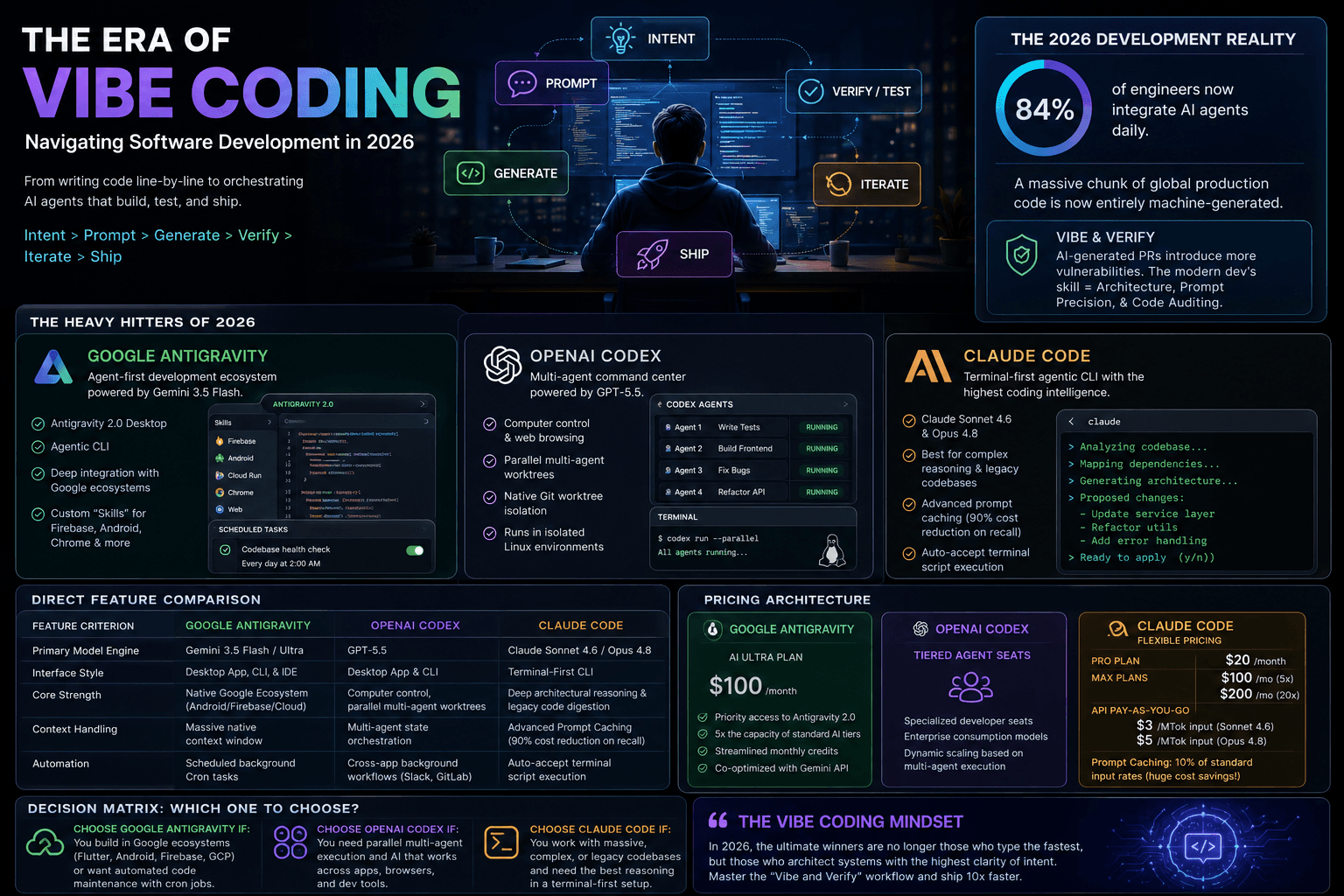
What is Vibe Coding? 2026 AI Software Dev Guide & Comparison
Remember when "coding" meant staring at a text editor, hunting down a missing semicolon, and manually writing boilerplate CRUD (Create, Read, Update, Delete) routes?
Fast forward to 2026, and the landscape of software engineering has radically shifted. We have officially entered the age of Vibe Coding—a paradigm shift where developers act less like manual typists and more like directors, orchestrating ecosystems of highly autonomous AI agents.
According to recent developer data, over 84% of engineers now integrate AI agents daily, and a massive chunk of global production code is entirely machine-generated. It is no longer about micromanaging syntax; it’s about guiding intent.
If you want to stay ahead of the curve, you need to understand the premier agentic ecosystems dominating 2026: Google Antigravity, OpenAI Codex, and Anthropic’s Claude Code. Let’s break down what they are, how they compare, and which one you should choose based on your workflow and budget.
1. What is Vibe Coding? (The 2026 Development Reality)
Vibe Coding is an AI-driven development methodology where you describe your engineering goals in plain language, and the AI environment handles the heavy lifting of multi-file creation, execution, and debugging.
Instead of writing line-by-line, the engineering loop looks like this:
Intent > Prompt > Generate > Verify/Test > Iterate > Ship
While it dramatically compresses development timelines—turning month-long MVP builds into a matter of hours—it introduces a new engineering requirement: Vibe & Verify. Because AI-generated pull requests statistically introduce more security vulnerabilities, the modern developer's core skill has evolved from writing code to system architecture, prompt precision, and rigorous code auditing.
2. The Heavy Hitters of 2026: Core Profiles
Google Antigravity
Announced at Google I/O 2026, Google Antigravity has evolved from an IDE feature into a massive, agent-first development ecosystem. Powered by Gemini 3.5 Flash as its default engine, it is built heavily around the Model Context Protocol (MCP). It features Antigravity 2.0 (a standalone desktop command center), an agentic CLI, and custom "Skills" that anchor deep context into Firebase, Android, and Chrome web standards.
OpenAI Codex (GPT-5.5 Generation)
OpenAI has fully revitalized Codex for 2026, morphing it from a legacy code-completion API into a multi-agent desktop and terminal command center powered by GPT-5.5. Its standout trait is its deep computer-control capabilities, allowing agents to step outside the editor to browse the web, interact with local apps, manage Git worktrees natively to eliminate merge conflicts, and spin up isolated Linux testing environments.
Claude Code (Anthropic)
Claude Code is Anthropic's flagship agentic CLI tool, operating directly inside your terminal. It hooks seamlessly into Claude Sonnet 4.6 and the ultra-reasoning Claude Opus 4.8. Known for possessing the highest raw coding intelligence and best logical reasoning benchmarks, Claude Code excels at digesting vast, complex legacy codebases using advanced prompt caching to keep latency low.
3. Direct Feature Comparison
Feature Criterion
Google Antigravity
OpenAI Codex
Claude Code
Primary Model Engine
Gemini 3.5 Flash / Ultra
GPT-5.5
Claude Sonnet 4.6 / Opus 4.8
Interface Style
Desktop App, CLI, & IDE
Desktop App & CLI
Terminal-First CLI
Core Strength
Native Google Ecosystem (Android/Firebase/Cloud)
Computer control, parallel multi-agent worktrees
Deep architectural reasoning & legacy code digestion
Context Handling
Massive native context window
Multi-agent state orchestration
Advanced Prompt Caching (90% cost reduction on recall)
Automation
Scheduled background Cron tasks
Cross-app background workflows (Slack, GitLab)
Auto-accept terminal script execution
4. Pricing Architecture: Subscription vs. API
Choosing the right tool in 2026 relies heavily on understanding how you are billed. The platforms approach this via two main vectors: flat-rate subscriptions or pay-as-you-go API consumption.
Google Antigravity Pricing
- Google AI Ultra Plan: $100/month.
- What you get: Priority access to Antigravity 2.0, five times the capacity of standard AI tiers, and streamlined monthly credit systems co-optimized with the Gemini API ecosystem.
OpenAI Codex Pricing
- Tiered Agent Seats: Typically packaged into specialized developer seats or enterprise consumption models matching OpenAI's pro-developer tiers, adjusting costs dynamically based on multi-agent execution scaling.
Claude Code Pricing
Anthropic uses a hybrid strategy, allowing you to pool terminal usage with your subscription or pay purely via API tokens:
- Pro Plan: $20/month (Includes standard terminal CLI access with rolling token limits; best for solo devs).
- Max Plans: $100/month (5x Pro usage) or $200/month (20x Pro usage; engineered for heavy, multi-agent automated sessions).
- API Pay-As-You-Go: Charged per million tokens ($3/MTok input for Sonnet 4.6; $5/MTok input for Opus 4.8).
Cost-Saving Tip: Claude utilizes Prompt Caching. Repeated codebase reads are charged at just 10% of standard input rates, making large-scale operations highly affordable if configured correctly.
5. Decision Matrix: Which One to Choose When?
Choose Google Antigravity if:
- You are building heavily within the Google Web or Mobile Infrastructure. If your project relies on Flutter, native Android development, Firebase backends, or Google Cloud deployment, Antigravity’s pre-packaged "Skills" provide context no other tool can match.
- You want automated, background code maintenance. Its built-in Scheduled Tasks allow you to run automated codebase checkups on a standard cron schedule.
Choose OpenAI Codex if:
- You need Parallel Multi-Agent Execution. If you want to deploy four different agents at the exact same time—one writing tests, one building a frontend component, one triaging bugs, and one refactoring an API layer—Codex handles Git worktree isolation smoothly to prevent workspace corruption.
- Your workflow requires an AI that can step outside the code editor to interact with tools like Slack, Jira, or cross-platform browsers.
Choose Claude Code if:
- You are working in a Massive, Intricate, or Legacy Codebase. Anthropic's models routinely lead benchmarks for code comprehension and structural reasoning. If you need an agent to reliably map dependencies across thousands of lines of code without hallucinating variables, Claude Code combined with Opus 4.8 is the gold standard.
- You prefer a distraction-free, terminal-first environment that handles state execution right from your console.
Conclusion: The Vibe Coding Mindset
In 2026, software development isn't dying—it's being elevated. The entry barrier to building software has collapsed, meaning the ultimate winners in the tech landscape are no longer those who type the fastest, but those who architecture systems with the highest clarity of intent.
Whether you lean into the Google cloud ecosystem with Antigravity, leverage the multi-agent orchestration of Codex, or harness the pure cognitive horsepower of Claude Code, mastering the "Vibe and Verify" workflow is your ticket to a 10x production output.
To see a hands-on look at how these platforms operate in a real-world environment, watch the OpenAI Codex 2026 Agentic Walkthrough. This video demonstrates the shift toward full agentic autonomy, showing how modern AI platforms interact directly with desktop apps, terminal environments, and live development pipelines to automate end-to-end coding workflows.

About Rohit Kumar
Rohit Kumar is a web developer in Ranchi specializing in Next.js, React, Tailwind CSS, TypeScript, and modern full stack web applications.